Ascaso Espresso Machine Review: Is It Worth It?
 by Ella, Barista Trainer · Updated
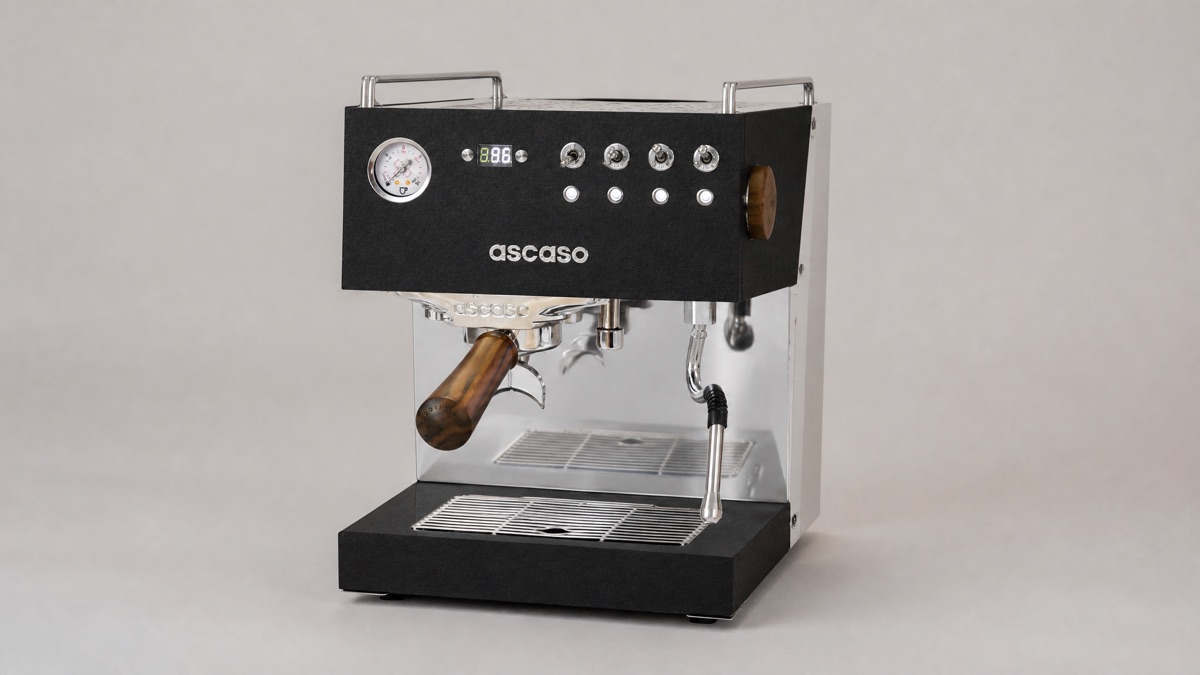
Welcome, I'm Ella, and today the Ascaso Steel Duo PID gets a barista's look. The Ascaso espresso machine is a family of semi-automatic home machines from Barcelona. The Steel Duo PID leads it with two thermoblocks and a 58 mm portafilter.
Working the bar at Nømad Coffee near the Arc de Triomf shaped how I judge thermoblock espresso machines. The Ascaso heats up in minutes, brews and steams at once, and repeats each shot with PID and volumetrics. The steam trails dual boilers.
I break the review into heat-up speed, steam power and power needs. Ascaso did not see it first. Rival matchups, prices, warranty and a verdict follow, so buyers can weigh the Uno, Duo Plus and Dream PID.
What Is the Ascaso Espresso Machine?
The Ascaso espresso machine is a semi-automatic home espresso machine from Ascaso, a Barcelona company. The Steel line adds a 58 mm portafilter, PID temperature control and a stainless steel body to a compact countertop frame.
Ascaso traces its coffee history to the mid 1950s in Spain. Espresso Parts has distributed the brand in North America since 2020.
The Dream line carries the retro look. Marc Aranyó designed the original Dream in 2000, and the PID version weighs only 22 lb (10 kg). Both lines come in several colors.
The Dream PID uses a single thermoblock rated at 1100 W. The machine weighs 10 kg (22 lb) and holds 1.3 L (44 oz) of water in a removable side tank.
Every home model is semi-automatic. The user starts and stops the shot, and the machine controls pressure and temperature. No Ascaso home model includes a grinder, so a separate burr grinder is a required purchase.
The Steel Duo PID box holds a tamper, a coffee scoop, four filter baskets and a blind basket. Buyers choose black, stainless steel or white.
Ascaso also builds commercial machines, such as the Barista T Plus and Baby T Plus. Those suit cafes and coffee carts rather than a kitchen counter.
Which Ascaso Espresso Machine Models Suit a Home?
Four Ascaso espresso machine models suit a home: the Steel Uno PID, Steel Duo PID, Steel Duo Plus and Dream PID. Each one pairs a 58 mm portafilter with PID control, but the heating setup differs.
The Steel Uno PID uses a single thermoblock. The machine draws 1050 W and weighs 12 kg (26.5 lb). Brewing and steaming share one heater, so milk waits until the shot ends.
The Steel Duo PID adds a second thermoblock for steam. The Duo draws 2000 W and weighs 15 kg (33 lb). Shots and milk run together.
The Steel Duo Plus keeps that dual design. A joystick steam lever, a 200 micron competition shower screen and a stainless steel tamper set it apart. The Plus also ships with 1-hole and 3-hole steam tips.
The Dream PID suits buyers who want a simpler retro machine. The Dream PID has an active cup warmer, volumetric control and an adjustable over-pressure valve. An ESE pod filter fits too.
Home Model Specs:
| Model | Heating | Power | Weight |
|---|---|---|---|
| Steel Uno PID | Single thermoblock | 1050 W | 12 kg (26.5 lb) |
| Steel Duo PID | Dual thermoblock | 2000 W | 15 kg (33 lb) |
| Steel Duo Plus | Dual thermoblock | 2000 W | 15 kg (33 lb) |
| Dream PID | Single thermoblock | 1100 W | 10 kg (22 lb) |
How Does the Ascaso Espresso Machine Work?
The Ascaso espresso machine works by pulling water from a 2 L (68 oz) side tank and heating it instantly in thermoblocks. A vibratory pump pushes the water through the coffee, and a gauge shows group pressure.
Brewing targets 9 bar of pressure at the group. The gauge, called a manometer, lets the user confirm that figure during extraction and set the over-pressure valve.
A flowmeter counts the water that passes through the pump. That count drives the volumetric doses, so the machine measures water volume rather than the espresso in the cup.
Four retro toggle switches run the Steel Duo PID, and each one starts a different function:
- Hot water: This switch starts the hot water flow.
- Single shot: This switch starts a single shot.
- Double shot: This switch starts a double shot.
- Steam: This switch starts steam.
A small digital display handles settings.
Cleaning runs through a built-in CLn mode. The mode supports a weekly detergent backflush with a blind basket.
How Do Dual Thermoblocks Work in the Ascaso Espresso Machine?
Dual thermoblocks work in the Ascaso espresso machine by giving brewing and steaming their own heating element. Water flows through a thermoblock and heats on the way out, so no large tank of water needs preheating.
Because each job has its own block, one block feeds the group head, and the second block makes steam. A barista can pull a shot while texturing milk, with no wait between the two jobs.
Heating water only as it flows has a cost and a benefit. A thermoblock holds no large reserve of hot water or steam. A dual boiler holds more water at temperature, which suits heavy milk sessions. A thermoblock reaches working temperature in minutes and uses less power at rest. Thermoblocks trade steam reserves for speed and efficiency.
This design places the Steel Duo PID in its own category. The machine is neither a heat exchanger nor a dual boiler. It is a dual thermoblock design, built for fast daily use.
Water that heats on the way out still needs steady temperature control. A PID controller adjusts heater power continuously instead of switching the heater on and off. That steady adjustment keeps brew temperature within a narrow band.
What Do PID and Volumetrics Do on the Ascaso Espresso Machine?
PID and volumetrics give the Ascaso espresso machine steady temperature and repeatable shot volume. The PID holds brew temperature within ±1.5 °C (2.7 °F), and the volumetric buttons replay a stored dose.
The brew temperature range runs from 80 °C to 110 °C (176 °F to 230 °F) in 1 °C steps. Steam temperature runs from 110 °C to 165 °C (230 °F to 329 °F).
The single and double buttons each store a programmed volume. After the user sets a dose, the machine stops each shot at that same volume.
Pre-infusion can be programmed for up to 5 seconds. Low pressure first soaks the puck, which helps even out the extraction.
Key Settings:
- Brew temperature from 80 °C to 110 °C
- Steam temperature from 110 °C to 165 °C
- Pre-infusion up to 5 seconds
- Over-pressure valve from 6 bar to 9 bar
An externally adjustable over-pressure valve sets the pump pressure. Owners can run profiles from 6 bar to 9 bar.
What Are the Benefits of the Ascaso Espresso Machine?
The benefits of the Ascaso espresso machine are PID control, volumetric dosing, programmable pre-infusion and a pressure gauge in a compact body. All four come standard on the Steel Duo PID.
The housing is full metal. Only the water tank and drip tray are plastic. Walnut accents sit on the steam control and the portafilter handle.
The Steel Duo PID measures 27 cm wide, 36 cm tall and 31.5 cm deep (10.6 by 14.2 by 12.4 in). The 2 L side tank slides out without moving the machine.
Coffeedant scored the Steel Duo PID 4.35 out of 5. Sub-scores ran 8.6 for espresso, 8.5 for milk, 9.0 for workflow and 8.5 for build.
Does the Ascaso Espresso Machine Heat Up Fast?
Yes. The Ascaso espresso machine heats up fast, reaching a first shot in about two to five minutes. Ascaso claims it is ready in one minute.
Testers measured longer times than that claim, though still short ones. LukeMakesCoffee saw 2 minutes, and Coffeeness saw about 3 minutes. Coffeedant put a good first shot at about 5 minutes.
Full heat soak takes longer. The group head and portafilter are thick metal parts that hold the coffee. They need roughly 10 to 15 minutes to warm through. Pulling a blank shot, which runs water through the machine without coffee, speeds up that warm-up.
A programmable standby and auto-start save the wait. Setting the machine to wake before breakfast lets the metal heat up before anyone pulls a shot. The first cup then avoids the cold-metal problem.
Does the Ascaso Espresso Machine Steam Milk Well?
Yes. The Ascaso espresso machine steams milk well for one or two drinks at a time. The V2 models make about 25% more steam than earlier versions.
Speed tests show what that means in practice. LukeMakesCoffee froths a single cappuccino in 25 seconds. Two cups take 45 seconds.
Coffeedant heated 200 ml (6.8 oz) of milk from 5 °C to 60 °C (41 °F to 140 °F) in 30 to 35 seconds on a 20 A unit. A 15 A unit needed 40 to 45 seconds.
The wand stays cool to the touch because of its double wall. The Duo Plus adds a joystick lever for finer control and 1-hole and 3-hole tips.
Large orders are where the machine falls short. The Duo uses a thermoblock, which heats water as it flows through. Thermoblock steam is wetter and weaker than steam from a dual boiler. A dual boiler keeps hot water and steam ready in separate tanks. For that reason, large milk sessions strain the Duo more than a boiler machine.
What Are the Downsides of the Ascaso Espresso Machine?
The Ascaso espresso machine has downsides tied to its thermoblock design: weaker steam than dual boilers and no flow control. Buyers who want profiling or heavy milk service find the limits quickly.
Steam trails dual boiler machines. The machine also has no flow control or profiling.
The pump adds a second limit. The machine uses a vibration pump, which buzzes under load. The noise is typical for this pump type, though owners describe the pump as well dampened.
Dosing by volume brings another issue. Volumetric doses drift when the grind changes. The flowmeter sits upstream of the over-pressure valve, so it does not measure exactly what reaches the cup. A scale gives the most accurate 1:2 ratio.
Some missing features affect daily use. The Steel Duo has no low-water warning. The steam thermoblock also stays warm unless the user disables it in settings.
A few parts of the build and setup also fall short. The box tamper is plastic, and Coffeeness advises replacing it with a metal one. Some 2022 units showed a display offset of 2 °C to 4 °C (3.6 °F to 7.2 °F), which a calibration fixes.
Water quality affects the thermoblock too. Scale builds up inside its narrow channels. Ascaso recommends filtered water, or routine descaling with its Coffee Washer when the machine runs on tap water.
Over time, some parts wear. Known wear points are steam valve play, switch feel and manometer calibration drift. Each is manageable, and spare parts and diagrams are easy to find.
Main Downsides:
- Steam trails dual boiler machines
- No flow control or profiling
- Vibration pump buzz under load
- Volumetric doses drift with grind changes
- No low-water warning
What Power Does the Ascaso Espresso Machine Need?
The Ascaso espresso machine needs a 120 V outlet, and some models need a 20 A circuit. The Steel Uno runs on a standard 15 A US outlet.
The Steel Duo Plus draws 20 A at 120 V. Ascaso USA recommends a dedicated circuit for it.
The Steel Duo PID comes in both 15 A and 20 A versions in North America. Buyers check the plug type before ordering.
Under the same test conditions, the 20 A units steam faster than the 15 A units.
How Does the Ascaso Espresso Machine Compare With Rivals?
The Ascaso espresso machine compares with dual boiler and heat exchanger rivals at similar prices, winning on speed and depth. At 31.5 cm (12.4 in), the Steel Duo is shallower than most rivals.
Dual boilers answer with stronger steam and steadier temperature in long sessions. The Lelit Elizabeth, Profitec Pro 300 and Rancilio Silvia Pro X all steam harder.
Coffeedant tabulated heat-up times for these rivals. The Elizabeth takes 10 to 15 minutes and the Silvia Pro X 10 to 20 minutes. The Lelit Mara X needs 20 to 30 minutes.
Prices span a wide range. The Rancilio Silvia costs $995, the Silvia Pro X $2,195 and the Linea Micra about $3,900.
Rival Comparison:
| Machine | Heating | First shot | Price |
|---|---|---|---|
| Ascaso Steel Duo PID | Dual thermoblock | About 5 minutes | $1,995 to $2,295 |
| Rancilio Silvia | Single boiler | Not tested | $995 |
| Rancilio Silvia Pro X | Dual boiler | 10 to 20 minutes | $2,195 |
| Breville Dual Boiler | Dual boiler | 10 to 15 minutes | $1,399 to $1,699 |
| Linea Micra | Dual boiler | About 10 minutes | About $3,900 |
Ascaso Espresso Machine vs Rancilio Silvia: Which Is Better?
The Ascaso espresso machine beats the Rancilio Silvia on features, while the Silvia wins on price. The Silvia costs $995, roughly half the Duo price.
The Silvia is a single boiler machine. Milk has to wait until the shot finishes, while the Duo steams during extraction.
The Silvia ships with a real tamper and a 58 mm portafilter. The Steel Duo adds PID menus, volumetrics and pre-infusion.
The Silvia Pro X is the closer rival. The Pro X costs $2,195 and has stronger steam, but it is deeper and slower to stabilize.
Ascaso Espresso Machine vs Breville Dual Boiler: Which Is Better?
The Ascaso espresso machine wins on speed and size, while the Breville Dual Boiler wins on steam power. The Breville steams harder and offers a forgiving workflow.
Speed shows up first, at the start of each day. The Breville Dual Boiler needs 10 to 15 minutes to heat up. The Ascaso reaches a first shot in about five.
Size matters next, because a machine must fit the counter it sits on. The Breville chassis is 37 to 38 cm (14.6 to 15 in) deep. The Steel Duo measures 31.5 cm (12.4 in), which suits tight counters.
Price decides the rest. The Breville costs $1,399 to $1,699. Value seekers and tinkerers lean Breville, and speed seekers lean Ascaso.
Ascaso Espresso Machine vs Breville Barista Pro: Which Is Better?
The Ascaso espresso machine offers a larger portafilter, dual heaters and finer control than the Breville Barista Pro, which wins on price and convenience. The Barista Pro lists at $849.95 at US retailers.
The Breville Barista Pro has a built-in grinder. The beans, the grinder and the machine sit in one box on the counter. Its portafilter, the handle that holds the ground coffee, is 54 mm wide. Its ThermoJet heater reaches extraction temperature in about three seconds, by Breville's own claim.
The Ascaso uses a 58 mm portafilter, the same size found on commercial machines. It needs a separate grinder.
Buyers who want one box on the counter lean Breville. Buyers who want commercial-size tooling lean Ascaso.
How Much Does the Ascaso Espresso Machine Cost?
The Ascaso espresso machine costs about $2,000 for the Steel Duo PID and more for the Duo Plus. Coffeedant found street prices of $1,995 to $2,295 for the Duo PID in late 2025.
The Steel Duo Plus runs from $2,299 to $2,599 at the same time. Commonly Coffee cited a price near $2,000 for the Plus.
Ascaso USA lists the Steel Duo PID at $2,095 and the Steel Duo Plus PID at $2,415. The Dream PID sells for $1,635 in most colors and $1,735 in aluminum.
Price Ranges:
| Model | Price |
|---|---|
| Dream PID | $1,635 to $1,735 |
| Steel Duo PID | $1,995 to $2,295 |
| Steel Duo Plus | $2,299 to $2,599 |
Used and refurbished units sit 15% to 25% below new tags. Warranty terms on those units vary by retailer.
The price covers only the machine. A grinder, a metal tamper, a scale and a milk pitcher are separate purchases.
What Warranty Covers the Ascaso Espresso Machine?
The Ascaso espresso machine warranty covers the thermoblock and group system for 5 years. Ascaso USA lists this term for the Steel Uno and Duo Plus.
All other components carry a 1-year warranty. Pumps, valves and electronics fall under that shorter term.
Spare parts and diagrams are widely available, which helps once a part falls outside warranty. Regional distributors host the manuals, and Ascaso USA sells parts online.
Is the Ascaso Espresso Machine Worth It?
Yes. The Ascaso espresso machine is worth it for buyers who value speed, compact size and control over raw steam power. The Steel Duo PID earns a 4.35 out of 5 from Coffeedant.
The machine heats up fast and can brew and steam at the same time. A buyer can pull a shot and froth milk without waiting between the two steps. The body is compact stainless steel, so it fits on a small counter.
Control is the next strength. The machine has a PID, which is a controller that holds the water at a steady temperature. It also has volumetrics, which stop the shot at a set amount of water. It has pre-infusion too, which wets the coffee gently before full pressure.
The limits come from the same design. Steam trails dual boilers, which are machines with a separate boiler for brewing and for steam. The machine also lacks flow profiling, which lets a user change the water flow during a shot. Buyers who want either feature choose a dual boiler.
The machine uses a thermoblock, a heater that warms water as it passes through. Scale, the mineral buildup left by hard water, can collect in it, so it needs care.
Pros:
- Fast heat-up
- Simultaneous brew and steam
- PID, volumetrics and pre-infusion
- Compact stainless steel build
Cons:
- Steam trails dual boilers
- No flow profiling
- Thermoblock scale care
Who Should Buy the Ascaso Espresso Machine?
Weekday home baristas should buy the Ascaso espresso machine for fast first shots and one or two milk drinks at a time. Small counters and tight cabinet clearance also favor it.
Buyers who run large milk sessions are a poor fit. A dual boiler holds steam better across many drinks.
Flow-profiling fans are a poor fit too. The Ascaso has no native flow control.
Espresso-only kitchens on a tighter budget look at the Steel Uno instead. The Uno is a single thermoblock and cannot steam during a shot.
The Exploring Barista is reader-supported. Purchases made through links on this page may earn us an affiliate commission at no extra cost to you.