Arkel Coast Espresso Machine Review: Is It Worth It?
 by Ella, Barista Trainer · Updated
Hello, coffee friends, Ella here. I have tasted coffee in Taipei and far beyond, and it made me pickier about dual boiler espresso machines.
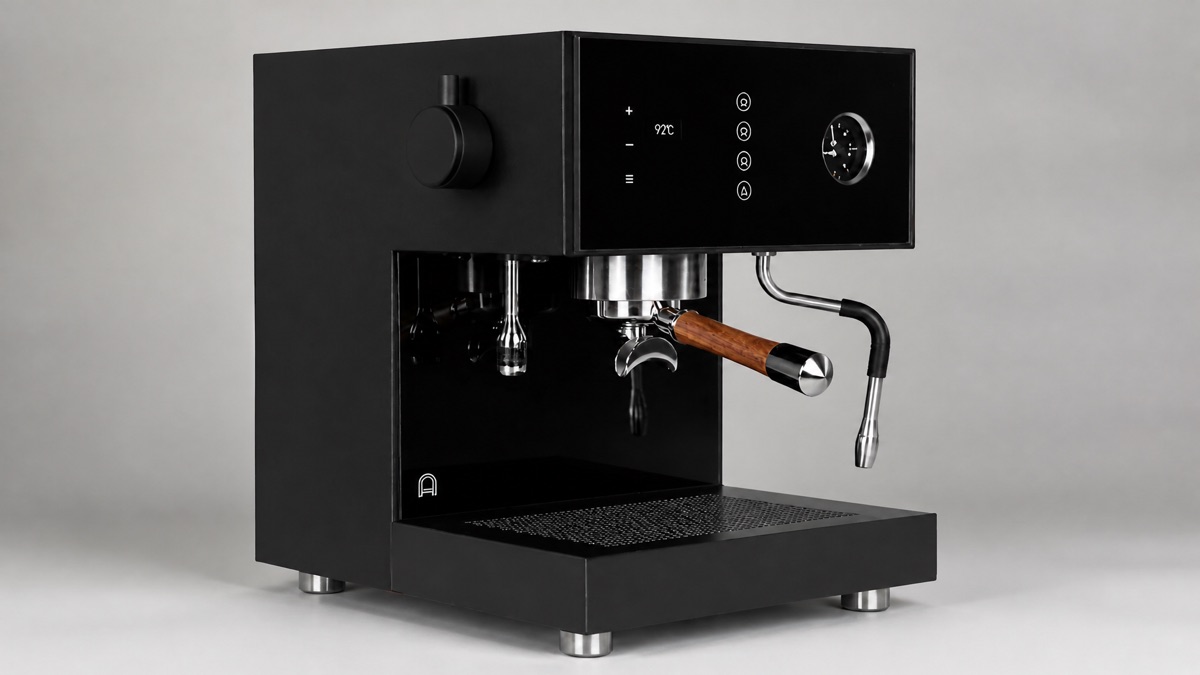
The Arkel Coast is a dual boiler espresso machine built in Porto, Portugal. It pairs a stainless steel body and a glass front panel with a manual needle valve for brew pressure. The US price is $2,699. It comes in black and white.
The Coast heats in about 12 minutes and steams milk fast and dry. The needle valve moves brew pressure from 9 bar to 1.5 bar. Temperature holds near the 93 °C setting, though the first shot runs cool. Steam pressure falls when a shot and milk run together.
A 3-year US warranty offsets some of the risk of a young brand. Shots are timed, not weighed, so a scale is part of the routine. From pressure control to warranty and price, I cover what a barista would check. No sponsor is involved.
What Is the Arkel Coast Espresso Machine?
The Arkel Coast espresso machine is a Portuguese dual boiler with a stainless steel body, a glass front panel and a manual valve for brew pressure. Arkel builds it for demanding home baristas with limited counter space.
Arkel describes the Coast as engineered like a commercial machine and downsized for smaller countertops. Two independent boilers, a PID temperature controller and a saturated brew group do the work.
The Coast is a semi-automatic machine. The programmable shot timer helps, but the user still grinds, doses, tamps and starts every shot. The Coast has no built-in grinder, so buyers need a separate espresso grinder.
Nick Brown of Whole Latte Love positions the Coast as an alternative to E61 group machines. Classic E61 dual boilers often need 25 to 30 minutes to heat. The Coast is ready in about 12.
The E61 is a group head design that Faema introduced in 1961. Ernesto Valente invented it. Water circulates from the boiler through a heavy brass group by thermosiphon, a loop driven by heat.
Nick Brown has worked at Whole Latte Love for over a decade. Kaffeemacher is a German and Swiss coffee company with its own cafés. Its team buys machines independently and tests them with a lab protocol.
The Coast is a home machine. A 2.5 L (85 oz) tank at the back feeds the pumps, and the machine has no option for a water line. The Coast is not NSF certified.
Who Makes the Arkel Coast?
Arkel Espresso makes the Coast in Porto, Portugal, under founder Fernando Moreira. Moreira previously worked at the Portuguese brand Briel. The Coast and its sibling, the Tide, are Arkel's first two machines.
A Portuguese team designs the Coast and assembles it at home. More than 95% of its parts are made by Arkel or bought from suppliers in the European Union.
Arkel designed the stainless steel 58 mm group head, the portafilter and the tamper in-house. The group head is the part that holds the portafilter and sends hot water through the coffee. Eastlink, the Australian importer, says the group uses replaceable brass rails as its wear part.
Whole Latte Love sells the Coast in the United States. Before Arkel, the retailer's only machines made in Portugal were select Jura super-automatics.
How Does the Arkel Coast Work?
The Arkel Coast works with two stainless steel boilers that heat brew water and steam separately. A 0.7 L (24 oz) boiler feeds the brew group. A 1 L (34 oz) boiler makes steam. Both boilers are vertical, insulated and fitted with drains.
The brew boiler mounts directly on the group, a layout Nick Brown calls a ring group. The boiler bolts straight onto the group, so it heats the group by contact. A 150 W cartridge heater also warms the group. An E61 group works differently. It holds a large mass of brass, and E61 machines need 25 to 30 minutes to heat.
A PID controller adjusts heater power in small steps to hold a set temperature. On the Coast, the PID regulates the brew boiler and shows its setting in Celsius.
Nick Brown reports one vibration pump per boiler. When the steam boiler refills, its own pump runs, so brew pressure stays steady. Nick Brown notes that the Gaggia Classic GT and Rancilio Silvia Pro X also use dual pumps.
Water travels from the 2.5 L (85 oz) tank to the pump, then through the needle valve to the brew boiler. From there it reaches the group and the portafilter. A three-way solenoid valve sends waste water to the drip tray, which leaves a dry puck.
Brewing uses three buttons instead of a lever. The single and double buttons run timed shots. A manual button starts and stops a shot by hand.
Pre-infusion wets the puck at low pressure before full pressure builds. It has two phases. The active phase pushes water into the puck. The passive phase lets the puck soak.
How Does the Arkel Coast Needle Valve Control Pressure?
The Arkel Coast needle valve controls pressure by restricting water between the pump and the boiler. One turn of the knob moves brew pressure from 9 bar fully open to 1.5 bar fully closed, based on Nick Brown's testing.
The valve sits early in the water line, before the boiler. Pressure changes arrive less abruptly. Less cold water also enters the boiler.
An E61 flow control works differently. It sits after the boiler and throttles water as it moves through the group. The Coast valve acts on the water before it is heated. The two devices change the shot at different points.
The valve needs a ceiling to work from. An adjustable overpressure valve at the back, beside the tank, sets the top pressure. Arkel lists a default pump pressure of 9 bar and a maximum of 15 bar. Brew and steam gauges show the result in real time.
The needle valve stays cold because cold water passes through it. That helps it resist scale. The valve has one limit: an E61 device can stop flow completely, and the Coast valve cannot. The valve also changes the flow rate of hot water.
How Fast Does the Arkel Coast Heat Up?
The Arkel Coast heats up in about 12 minutes from a cold start. Arkel states under 12 minutes. Nick Brown and the German lab Kaffeemacher both measured about 12 minutes to brew and steam ready.
The 150 W group heater explains the speed. The heater warms the group and portafilter while the 0.7 L brew boiler comes up to temperature. Cold metal does not drag the first shot down.
Kaffeemacher measured 0.14 kWh for heat-up and the first shots with the steam boiler switched off. With steam on, heat-up plus five shots used 0.25 to 0.29 kWh. The steam switch controls most of the energy cost.
Kaffeemacher notes that thick-film heater machines reach temperature in about five minutes. The Coast is fast for a boiler machine but not the quickest design on the market.
What Features Does the Arkel Coast Have?
The Arkel Coast does have strong features: capacitive touch controls, programmable shots, pressure gauges and cleaning cycles. Four buttons sit in the center of the glass panel: two programmable shot buttons, a continuous shot button and a hot water button.
The PID panel has plus and minus buttons and a dedicated menu button. Temperature changes in 1 degree Celsius steps. The menu holds the shot counter, pre-infusion settings, eco mode, a backflush cycle and a descaling cycle.
Menu Options:
- Shot counter
- Pre-infusion settings
- Eco mode
- Backflush cycle
- Descaling cycle
Holding a shot button for six seconds records a new shot time. Both shot buttons share one pre-infusion setting. The continuous button ignores pre-infusion.
Hot water comes from the brew boiler rather than the steam boiler. Water leaves the spout without sputtering. A fill probe in the brew boiler triggers the pump to refill it as needed.
The Coast has no cup warmer on top. Kaffeemacher scored noise 8 out of 10.
Lights in the hood light up a large cup area. The removable stainless drip tray holds 1.2 L (41 oz) in Kaffeemacher's measurement.
What Comes in the Arkel Coast Box?
The Arkel Coast box comes with a wood-handle 58 mm portafilter, a matching tamper and IMS filter baskets. Arkel designed the portafilter and tamper itself. The stainless portafilter weighs about 2 lb (0.9 kg).
IMS single and double baskets come with the machine. Kaffeemacher measured only 0.65 mm of play between the tamper and the basket, and rated the accessories 8 out of 10.
A cleaning kit rounds out the box: a cleaning brush, a Brita water filter, descaler, cleaning powder and a barista cloth.
Included Items:
- Wood-handle 58 mm portafilter
- Wood-handle 58 mm tamper
- IMS single basket
- IMS double basket
- Cleaning brush
- Brita water filter
- Descaler and cleaning powder
- Barista cloth
A bottomless portafilter is sold separately. Nick Brown recommends a BWT water filter instead of the included Brita.
How Well Does the Arkel Coast Make Espresso?
The Arkel Coast makes good espresso, and Kaffeemacher scored its espresso potential 7 out of 10. The lab gave the machine an overall 63.3 out of 100, a Good/Standard rating, with the needle valve as its strongest tool.
The vibration pump builds pressure slowly, and the needle valve slows the ramp even more. This gives a low-pressure pre-infusion, a gentle wetting of the coffee at the start of the shot. Light roasts benefit from it, and the gentle wetting tames acidity.
Gentle wetting also helps with channeling. Channeling happens when water cuts a fast path through the puck, the packed bed of ground coffee. The rest of the coffee then stays under-extracted. Low pressure early in the shot lowers that risk.
Pressure profiling means changing pressure during a shot. Lowering pressure to 6 or 4 bar late in a shot cuts bitterness.
The same control can rescue a bad shot. Kaffeemacher calls the valve a lifesaver: a shot that runs too fast can be saved by dropping pressure to 6 or 7 bar.
Shots are programmed by time, not volume, and output changes whenever the grind or valve changes. Kaffeemacher scored volumetrics 3 out of 10. It says a scale is the only way to repeat a recipe.
How Stable Is the Arkel Coast Temperature?
The Arkel Coast keeps a stable temperature, averaging 92.87 °C (199.2 °F) against a 93 °C (199.4 °F) setting. Kaffeemacher measured this once the machine was warm. Nick Brown also called the brew temperature very stable.
The first shot of the day ran cooler, at 91.40 °C (196.5 °F), about 1.5 °C below steady state. A blank shot through the empty portafilter removes the gap.
Temperature rises during extraction. Shot five started at 92.13 °C (197.8 °F) and ended at 94.03 °C (201.3 °F). Heat late in a shot emphasizes bitterness. Kaffeemacher scored temperature 6 out of 10.
Temperature Test Results:
| Measurement | Result |
|---|---|
| Steady-state average (93 °C setting) | 92.87 °C (199.2 °F) |
| First shot of the day | 91.40 °C (196.5 °F) |
| Start of shot five | 92.13 °C (197.8 °F) |
| End of shot five | 94.03 °C (201.3 °F) |
| At the puck with a 92 °C display | 93.5 °C (200.3 °F) |
The number on the display is not the number at the coffee. At a displayed 92 °C, about 93.5 °C (200.3 °F) reached the coffee. The display works in Celsius only, so Fahrenheit users convert.
How Well Does the Arkel Coast Steam Milk?
The Arkel Coast steams milk fast and dry. Nick Brown heated 142 g (5 oz) of cold milk to 140 °F (60 °C) in 12.25 seconds on average. Added water stayed just under 11%.
Dry steam carries little water, so the milk is not thinned. The added water of just under 11% in Nick Brown's test shows the steam was dry.
Speed held up with larger portions. Kaffeemacher heated a large portion to 60 °C (140 °F) in 23 seconds and called the machine a fog machine. The lab scored frothing 8 out of 10. It saw little slowdown across several 0.6 L (20 oz) pitchers.
Nick Brown measured recovery between back-to-back milk drinks at about 32 seconds on average. The steam wand is large, fully articulated and mounted on the right side.
A pressure stat, which switches the heater on and off, sets steam pressure. Pressure idles near 1.8 bar (26 psi), and the setting is not adjustable. A knob that matches the needle valve opens steam, and pushing it up gives a quick purge jet.
Can the Arkel Coast Brew and Steam at Once?
Yes. The Arkel Coast can brew and steam at once, but steam pressure falls while the shot runs. One owner who pulled about 80 shots saw pressure drop to around 0.7 bar during a combined run.
Eastlink says the Coast cuts steam boiler power during extraction to protect brew temperature.
The same owner waited about 2.5 minutes for the steam boiler to reheat. Steaming after the shot, instead, kept pressure above 1.5 bar and recovered in under 30 seconds.
Some settings make the drop worse. Eastlink says the effect grows with milk volumes above 400 to 450 ml (14 to 15 oz). It also grows with turbo shots and pre-infusion of 50 to 60 seconds.
Eastlink steamed milk for two large lattes in a row, with a recovery of about 1.5 minutes. The simplest habit is to pull the shot first and steam second.
What Are the Arkel Coast Downsides?
The Arkel Coast has four listed downsides: fixed steam pressure, Celsius-only temperatures, time-based shots and no auto on/off timer. Nick Brown lists these under things to consider.
The brew group sits deep and out of sight. Kaffeemacher found that inserting the portafilter takes practice at first. The portafilter handle is thin, and some hands will find it less firm.
The machine stands 16 inches (405 mm) tall. Owners with low cabinets need to check clearance. The tank refills from the back, and the machine cannot connect to a water line.
Temperature rises about 2 °C during a shot, and the first shot runs cool. Kaffeemacher scored price against performance only 4.5 out of 10 at its European price.
Listed Downsides:
- Fixed steam pressure
- Celsius-only temperatures
- Time-based shot programming
- No auto on/off timer
Each downside has a workaround. A scale handles time-based dosing, because output can be weighed. A blank shot fixes the cool first shot. Steaming after the shot avoids the pressure drop. A plug-in timer switch can start the machine each morning.
Is the Arkel Coast a Risky Buy From a New Brand?
Yes. The Arkel Coast is a risky buy because Arkel is a new brand with a short track record. Forum buyers worry about long-term support and whether the company lasts in a crowded segment.
The design itself lowers some of that risk. More than 95% of the parts come from Arkel or EU suppliers. The group uses replaceable brass rails. Both boilers drain, which simplifies descaling and repair.
Support in the United States also reduces the worry. Whole Latte Love handles warranty service and sells parts. Arkel also offers a technical question form and a downloadable manual on its site.
The maker has also shown it will fix problems. Early units used a ball valve for pressure control, and Arkel moved to the needle valve soon after release.
How Does the Arkel Coast Compare to Rival Machines?
Buyers compare the Arkel Coast to rival machines like the Profitec Move and the Lelit Elizabeth. Forum threads weigh these ring-group dual boilers against the Coast because they cost less than most E61 dual boilers.
Nick Brown notes that the Profitec Move uses the same ring group layout as the Coast. The Coast adds a manual pressure valve and an actively heated group.
The boilers differ in size. The Profitec Move holds 0.22 L (7.4 oz) in its brass brew boiler and 0.75 L (25 oz) in its stainless steam boiler. The Coast carries 0.7 L (24 oz) and 1 L (34 oz). The Move heats in about 9 minutes with Fast Heat Up on.
The Lelit Elizabeth is the other rival. Lelit builds it with two boilers and the LELIT58 commercial group. It has been on sale for about five years, which gives it a longer track record than the Coast.
Other dual boilers share some of these traits. Nick Brown notes that the Gaggia Classic GT and Rancilio Silvia Pro X also use dual pumps and a right-side steam wand. E61 machines remain the heat-up laggards at 25 to 30 minutes.
Coast, Move and Tide Compared:
| Machine | Brew boiler | Steam boiler | Heat-up |
|---|---|---|---|
| Arkel Coast | 0.7 L (24 oz) | 1 L (34 oz) | 12 minutes |
| Profitec Move | 0.22 L (7.4 oz) | 0.75 L (25 oz) | About 9 minutes |
| Arkel Tide | 0.5 L (17 oz) | 0.7 L (24 oz) | 9 minutes |
How Does the Arkel Coast Differ From the Arkel Tide?
The Arkel Tide differs from the Arkel Coast by using a variable-speed gear pump that connects to a water line. The Coast uses a vibration pump and a 2.5 L (85 oz) tank.
The pump type changes how each machine controls pressure. The Tide uses a potentiometer, a dial that changes the pump speed. Pressure ramps more slowly than with the Coast needle valve. The Tide can also stop flow completely, and the Coast valve cannot.
The two controls also cover different pressure ranges. One turn of the Tide potentiometer goes from 9.5 bar fully open to 3 bar fully restricted. The Coast valve sweeps a wider range, from 9 bar to 1.5 bar.
The gear pump is larger, so it also changes the boilers. The Tide boilers are shorter to make room for it. They hold 0.5 L (17 oz) for brewing and 0.7 L (24 oz) for steam. The Tide heats in about 9 minutes against 12 for the Coast.
The interface and programming menu are identical on both machines. The choice comes down to priorities. Buyers who want plumbing choose the Tide. Buyers who want the quickest valve response choose the Coast.
How Much Does the Arkel Coast Cost?
The Arkel Coast costs $2,699 at Whole Latte Love in black or white. The price places the machine above entry-level dual boilers and below the cult machines from La Marzocco.
The Profitec Move costs $2,249 at the same retailer, which is $450 less than the Coast. The Arkel Tide costs $3,499, which is $800 more.
The machine price is not the full cost of starting. The Coast has no grinder and no scale. Buyers must add a capable espresso grinder and a scale to the $2,699.
Kaffeemacher scored the Coast 4.5 out of 10 for price against performance at its European price. The lab praised the build and steam. It marked the machine down for time-based dosing and the cool first shot.
Running costs stay low with the steam boiler off. Heat-up and first shots used 0.14 kWh in Kaffeemacher's test. With steam on, five shots used up to 0.29 kWh.
Drains on both boilers let an owner descale without opening the machine. Kaffeemacher says a professional descaling service every two to three years adds real cost on other boiler machines.
Does the Arkel Coast Have a Warranty?
Yes. The Arkel Coast does have a 3-year parts and labor warranty in the United States. Whole Latte Love is the warranty service provider.
Arkel sells to European buyers on its own store.
Arkel offers two voltage versions. The US version runs on 110 to 120 V. The EU version runs on 220 to 240 V. Buyers should match the version to their country.
Black and white finishes are available.
Is the Arkel Coast Worth It?
Yes. The Arkel Coast is worth it for a home barista who wants pressure control without the long E61 warm-up. Kaffeemacher gave it 63.3 out of 100, a Good/Standard result.
The strengths are a 12-minute heat-up, strong steam, a responsive needle valve and a premium stainless build. Kaffeemacher scored steam 8, noise 8, accessories 8 and build quality 7.5 out of 10.
Kaffeemacher's lower scores were temperature 6, espresso 7, price against performance 4.5 and volumetrics 3 out of 10. Those scores come from the cool first shot, the rising temperature and the time-based dosing.
The weaknesses are fixed steam pressure, Celsius-only settings, time-based shots, no auto on/off and a steam pressure drop during combined brewing and steaming. Temperature also rises about 2 °C in a shot.
The price of $2,699 asks a buyer to accept a young brand. The warranty and the parts quality offset much of that risk.
Pros:
- 12-minute heat-up
- Strong, dry steam
- Responsive needle valve
- Stainless build with mostly EU parts
Cons:
- Fixed steam pressure
- Celsius-only settings
- Time-based shots
- Steam pressure drop during combined brewing and steaming
Who Should Buy the Arkel Coast?
A home user who pulls one or two milk drinks at a time should buy the Arkel Coast. The quick morning heat-up and manual pressure profiling suit that routine.
Buyers who need plumbing, volumetric dosing, an on/off timer or steady simultaneous brewing and steaming should skip the Coast. The Tide solves the plumbing problem.
Buyers who value a long track record can look at the Profitec Move or the Lelit Elizabeth. Both have been on sale longer.
The Coast needs 16 inches (405 mm) of height and about 15 inches (38 cm) of width and depth. Check the space before ordering.
The Exploring Barista is reader-supported. Purchases made through links on this page may earn us an affiliate commission at no extra cost to you.