Amaste Espresso Machine Review: Is It Worth It?
 by Ella, Barista Trainer · Updated
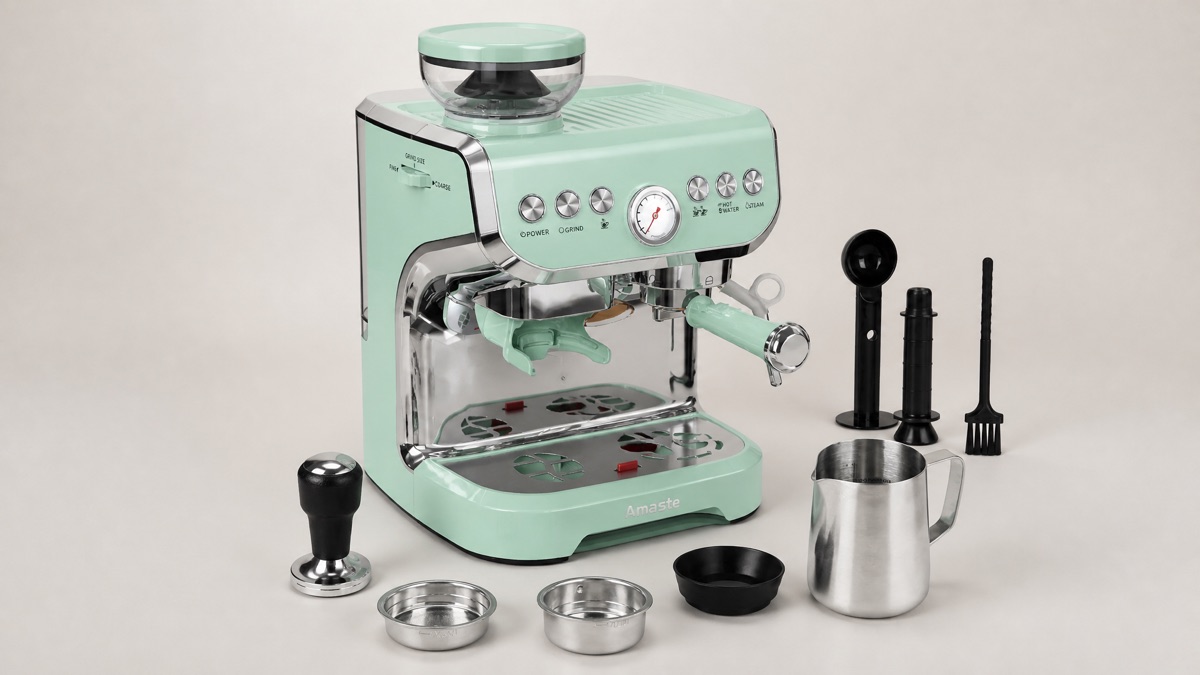
The Amaste espresso machine is a semi-automatic home espresso maker. It has a built-in conical burr grinder, a 15-bar pump and a manual steam wand in a retro body.
Hello, I'm Ella, and I have spent my career behind espresso bars. I have worked with espresso machines with grinders from many makers, and Amaste has a reputation worth checking.
Ratings average 4.0 out of 5 stars across 176 ratings. Buyers praise the looks, the grinder and the steam wand. The instruction booklet gets complaints.
This review covers specs and ratings, price and complaints and who should buy, and Amaste had no input.
What Is the Amaste Espresso Machine?
The Amaste espresso machine is a semi-automatic espresso maker with a grinder, a 15-bar pump and a steam wand. Amaste sells the green version as model AC-517E. It uses a retro design and runs on 120 V.
The machine comes in matcha green, white and blue. The white version carries model number AC-517EA. Amaste sells the machine through its own Amazon store.
The term semi-automatic describes how much work the user does. The user grinds, tamps, brews and froths milk by hand. Buttons start each step. The machine accepts whole coffee beans only.
The machine is also all-in-one. The grinder, pump and steam wand are in one body, so a separate grinder is not needed. A super-automatic machine does the tamping and shot timing alone. The Amaste does not.
What Comes in the Box With the Amaste Espresso Machine?
The Amaste espresso machine comes with a full barista kit in the box. The kit holds a 51 mm stainless steel portafilter, a tamper, a latte art pitcher, a dosing ring, a cleaning brush, a cleaning needle and a tamping spoon.
Single and double portafilter baskets come in the box. The single basket suits a lighter shot. The double basket suits a stronger one.
Box Contents:
- 51 mm stainless steel portafilter
- Single and double baskets
- Tamper and tamping spoon
- Latte art pitcher
- Dosing ring
- Cleaning brush and cleaning needle
Amaste promises a reply to support requests within 24 hours.
How Does the Amaste Espresso Machine Work?
The Amaste espresso machine works in four hand-controlled steps: grind, tamp, brew and steam. The user grinds beans into the portafilter, tamps the grounds, locks the portafilter in and starts the shot. Milk gets frothed with the steam wand.
The brew step depends on two parts: a 1450 W heater and a 15-bar pump. The heater warms the water, and the pump pushes it through the grounds. A visual pressure gauge shows extraction pressure. This is the force on the water as it takes flavor from the coffee. The listing names 9 to 12 bar as the target range for a good shot.
The gauge reads lower than the pump rating. The 15-bar figure is the pump maximum, not the pressure at the coffee. An over-pressure valve diverts excess pressure back to the reservoir or drip tray. That valve holds brew pressure near 9 bar.
Low-pressure pre-infusion starts every shot, and the pump raises pressure gradually. The gentle start wets the grounds evenly before full pressure arrives.
With the brew and steam steps in place, the machine makes single and double espresso, Americanos, lattes and cappuccinos. The machine does not brew drip coffee. The machine does not take coffee pods.
Does the Amaste Espresso Machine Grind Beans?
Yes. The Amaste espresso machine grinds beans with a built-in conical burr grinder that has 15 settings. Conical burrs crush beans between two ridged cones. The settings run from coarse to fine, so the grind can match the coffee being made.
A portafilter cradle holds the portafilter, the handle that holds the coffee basket, in place during grinding. The cradle frees both hands, and the grounds drop straight into the basket.
Dialing in, which means adjusting the grind until the shot tastes right, starts near the middle setting. Shot speed then shows which way to move. A shot that runs too fast needs a finer grind. A shot that runs too slowly needs a coarser grind.
Does the Amaste Espresso Machine Froth Milk Automatically?
No. The Amaste espresso machine froths milk with a manual steam wand, not an automatic system. The machine has no milk tank. The user holds the pitcher and controls the steam.
A silicone cover on the steam wand protects the hand from heat. The cover keeps the wand safe to hold during frothing.
Manual frothing gives control over milk temperature and texture. The wand makes lattes, cappuccinos and flat whites. The same control suits latte art practice.
A new user needs practice to find the right pitcher angle and steaming time.
What Are the Amaste Espresso Machine Specs?
The Amaste espresso machine has specs of 1450 W, 120 V and a 15-bar pump. The 120 V rating suits US outlets. Use outside the United States may need a converter.
A gauge shows the live pressure, so a user can see where each shot is.
The machine has a built-in grinder, a conical burr unit with 15 grind settings. The settings run from coarse to fine.
The ground coffee then goes into the portafilter, the handle that holds the coffee in the machine. It measures 51 mm and is made of stainless steel. The machine includes single and double baskets, so a user can make one shot or two.
The water comes from the tank, which holds 68 oz (2 L) and lifts out for filling.
Key Specs:
| Spec | Value |
|---|---|
| Model | AC-517E (green), AC-517EA (white) |
| Power | 1450 W, 120 V |
| Pump | 15 bar |
| Grinder | Conical burr, 15 settings |
| Portafilter | 51 mm |
| Water tank | 68 oz (2 L) |
| Size | 11.61 x 11.02 x 16.14 in (29.5 x 28 x 41 cm) |
How Much Counter Space Does the Amaste Espresso Machine Need?
The Amaste espresso machine needs counter space of 11.61 in (29.5 cm) deep by 11.02 in (28 cm) wide. The body stands 16.14 in (41 cm) tall.
The packaged machine weighs about 9.14 kg (20.1 lb).
Does the Amaste Espresso Machine Make Good Espresso?
Yes. The Amaste espresso machine makes rich espresso with good crema for its price class. The 15-bar pump and pre-infusion support the extraction. Shots taste smooth and flavorful.
Fresh grinding adds to the flavor. The grinder gives good results. Beans ground right before the shot keep their aroma, so the espresso tastes fresher.
The steam wand gives a nice milk texture. Lattes and cappuccinos come out well once the user learns the wand.
Is the Amaste Espresso Machine Good for Beginners?
Yes. The Amaste espresso machine suits beginners who want to learn espresso at home. The machine is easy to use once the routine is set. The retro design and clear buttons keep the controls simple.
Practice is how the user finds the right grind and milk texture.
The tools needed for those first shots come in the box. A new user needs only fresh beans.
Is the Amaste Espresso Machine Easy to Clean?
Yes. The Amaste espresso machine is easy to clean thanks to a removable water tank and drip tray. Both parts come out for rinsing. Daily cleanup takes little time.
The portafilter needs a rinse after every shot. The steam wand needs a wipe right away.
Descaling removes mineral buildup from inside the machine.
What Do Amaste Espresso Machine Reviews Say?
Amaste espresso machine reviews average 4.0 out of 5 stars across 176 ratings on the green model's listing. The white model has 4.1 across 170 ratings.
Another listing, with 98 ratings, shows the spread. Most buyers gave the top score, but a small group gave the lowest.
Rating Split:
| Stars | Share of 98 ratings |
|---|---|
| 5 stars | 67% |
| 4 stars | 10% |
| 3 stars | 5% |
| 2 stars | 7% |
| 1 star | 11% |
What Are the Strengths of the Amaste Espresso Machine?
The strengths of the Amaste espresso machine are its retro design, built-in grinder and smooth, flavorful shots. The matcha green finish and compact body look stylish on a counter.
The built-in grinder grinds beans right before brewing. Pre-infusion adds an even start to each shot. Together, these two features make shots with crema, the light foam on top of espresso.
The 15-bar pump pushes hot water through the grounds. The shots taste smooth.
The steam wand heats and froths milk, so the machine makes lattes and cappuccinos at home.
What Are the Common Complaints About the Amaste Espresso Machine?
The Amaste espresso machine draws complaints about the instruction booklet.
The instruction booklet is hard to follow in places.
How Does the Amaste Espresso Machine Compare to Other Machines?
The Amaste espresso machine compares with entry-level machines from AMZCHEF, EUHOMY, Hanrose and Neretva. AMZCHEF offers 44 grind settings and a touchscreen. EUHOMY and Hanrose offer a 20-bar pump.
The portafilter is the handled basket that holds the coffee grounds. Its size affects which baskets and tampers fit. The Amaste portafilter measures 51 mm. EUHOMY and Neretva use a 58 mm portafilter.
The Breville Barista Express is the common benchmark for grinder machines. Breville lists a 54 mm portafilter, a 15-bar pump and 16 grind settings. Breville also lists a thermocoil heater with PID temperature control.
Machine Comparison:
| Machine | Portafilter | Pump | Grinder |
|---|---|---|---|
| Amaste AC-517E | 51 mm | 15 bar | 15 settings |
| Breville Barista Express | 54 mm | 15 bar | 16 settings |
| EUHOMY | 58 mm | 20 bar | Built in |
| Neretva | 58 mm | 15 bar | Not listed |
| AMZCHEF | Not listed | Not listed | 44 settings |
The Amaste combines a retro body, a grinder, a pressure gauge and a full kit.
Neretva and SUMSATY also have a visible pressure gauge on a retro body. The gauge alone does not set the Amaste apart.
How Does the 15-Bar Amaste Espresso Machine Compare to the 20-Bar Touchscreen Model?
The 20-bar touchscreen model compares to the 15-bar Amaste espresso machine with a touchscreen and an automatic milk frother. The pump runs at 20 bar.
The built-in frother draws milk straight from a container and mixes it with steam. Because the machine does this work, the user does not hold a pitcher.
An NTC thermistor is a small sensor that reads temperature. It keeps brew temperature between 197 and 204 °F (92 and 96 °C). This keeps the temperature steady between shots.
The 15-bar model adds a built-in grinder, a manual steam wand and a pressure gauge. The trade-off is that the 15-bar model has no automatic milk.
15-Bar vs 20-Bar:
| Feature | 15-bar AC-517E | 20-bar touchscreen model |
|---|---|---|
| Pump | 15 bar | 20 bar |
| Milk | Manual steam wand | Automatic frother |
| Controls | Buttons and gauge | Touchscreen |
| Temperature | Not listed | NTC, 197-204 °F (92-96 °C) |
How Much Does the Amaste Espresso Machine Cost?
The Amaste espresso machine costs one price that covers a grinder, a pump, a gauge and a barista kit.
The machine also comes in white as model AC-517EA. The green model is AC-517E.
Where Can You Buy the Amaste Espresso Machine?
Shoppers can buy the Amaste espresso machine on Amazon from Amaste itself.
Third-party stores such as Mercari and Desertcart also list the 15-bar model or its 20-bar sibling.
Is the Amaste Espresso Machine Worth It?
Yes. The Amaste espresso machine is worth it for beginners who want a grinder, gauge and steam wand.
Pros:
- Retro style
- Built-in grinder
- Pre-infusion
- Full barista kit
- Large 68 oz (2 L) tank
Cons:
- Thin instruction manual
- 51 mm accessory choice
The machine suits beginners and style-minded buyers. Buyers who want automatic milk or 58 mm accessories should look at other machines.
Who Should Buy the Amaste Espresso Machine?
Beginners should buy the Amaste espresso machine when they want a grinder and steam wand in one body. The machine teaches the full espresso routine.
The Amaste comes in three finishes, so looks can drive the choice.
- Beginners: The built-in grinder and steam wand let a new user learn every step of making espresso on one machine.
- Style-minded buyers: The matcha green, white or blue finish and the retro body suit a stylish kitchen.
- Buyers who want automatic frothing: The 20-bar touchscreen model has an automatic milk frother, so no wand is needed.
- Buyers who want upgrades: Those who want 58 mm accessories should shop elsewhere. The 51 mm basket limits upgrades.
The Exploring Barista is reader-supported. Purchases made through links on this page may earn us an affiliate commission at no extra cost to you.